

Intent
Art teaching at Signhills Infants Academy aims to give all children a strong understanding of their own uniqueness and creative abilities and to help build understanding of why art and artists are relevant to our history, our culture and contemporary society. Art is one way to improve creative and critical thinking skills whilst providing them with the knowledge to help them think artistically. Art creates an emotional outlet and promotes important life skills such as communication, independence, perseverance, problem solving, and the opportunity to experiment – essential for success in the STEM subjects.
Children will gain an understanding of a range of art techniques and processes and also an understanding of the implications of Art, from the past, today and in the future. The creative arts industries are currently dominated by people who were privately educated; schools that sell themselves on the kind of high quality artistic learning experiences that they can provide. As part of every child’s entitlement to a “broad and balanced curriculum” at Signhills, we endeavour to ensure that our creative arts curriculum is as robust and significant in the timetable as all other subjects.
“The great tragedy is that they're removing art completely, not because they're putting more science in, but because they can't afford the art teachers or because somebody thinks it's not useful. An enlightened society has all of this going on within it. It's part of what distinguishes what it is to be human from other life forms on Earth - that we have culture.” (Neil deGrasse Tyson, author and astrophysicist)
At Signhills Infant Primary Academy, Art will be holistic and outward looking in terms of approach, activities and artists, making the curriculum fully inclusive and relevant to all pupils. It will celebrate art as a unique subject through which children will develop their skills and personal sense of creativity and well-being. It will consist of pathways, focusing on a pedagogy-approach, these will be revisited in each year group. During each year’s pathways, the key concepts are suggested and disciplines mapped. This model supports the retrieval process for learning.
All children are encouraged and inspired to develop and use a range of skills including exploration, questioning and making as they progress through a journey of self-discovery and re-invention. Each journey allowing for the development of each child individually, encouraging them to be confident when expressing their ideas creatively. Specialist vocabulary for art is taught and built up, and effective questioning to communicate ideas is encouraged. By providing a safe structure to explore their creativity, the children are able to develop their creative risk taking and willingness to experiment.
Ultimately, a strong understanding of Art will allow children to understand and appreciate cultures in society, broaden their vocabulary, all the while developing a sense of creativity and critical thinking. Here at Signhills Infants our belief is “Our creativity is part of our humanity. If we fail to provide opportunities for pupils to develop their creativity, we are not only letting them down, but we are negatively affecting future society. That’s how important teaching art is.” (Paula Briggs, CEO & Creative Director, AccessArt)
Implementation
To ensure high standards of teaching and learning in art and design, we implement a curriculum that is progressive throughout the whole school. Art and design is taught as part of a half-termly topics, focusing on knowledge and skills that extends beyond the National Curriculum. At Signhills Infants, we ensure that art and design is given the same importance as the core subjects, as we feel this is important in enabling all children to gain ‘real-life’ experiences.
Teachers plan lessons for their class following Access Art pathways which are designed to inspire and enable high quality visual arts teaching and learning. We believe that art is far more than a series of technical skills, our holistic curriculum nurtures creative thinking skills and helps ensure children learn through art as well as about art. Our progression of knowledge and skills document ensures the curriculum is covered and the skills/knowledge taught is progressive from year group to year group. Our progression document also details the substantive and disciplinary knowledge the children will learn in each year group. Our art curriculum is knowledge rich and aims to develop knowledge and understanding that builds children to go beyond technical and factual knowledge. Our curriculum balances declarative knowledge with experimental knowledge, building self-knowledge and nurturing traits in learners which will hold them in good stead whichever direction a child’s learning takes them. Our art learning is built through weaving, layering and revisiting experiences. Each year the children acquire knowledge and skills in drawing, sketchbooks, print making, painting and collage as well as developing knowledge about a range of artists. Our curriculum is also supported by a range of talking points which are carefully curated to introduce children to a diverse variety of artists, designers and craftspeople. We juxtapose contemporary artists with more traditional artists to allow children the opportunity to revisit artists they have already studied. Each pathway tells a story and follows the format of:
-
Warm-up: activity: Critique/ Reflection
-
Artists: materials: Activity: Critique / Reflection
-
Challenge or Brief: Artist: Activity: Critique/ Reflection
We believe that creativity likes rhythm therefore each pathway follows a repeated rhythm which provides lots of time to balance repeated practice with new experiences, quiet approaches with active and dynamic activities, time to work alone but also with collaborative and community based activities… all geared to create energy and momentum throughout the year.
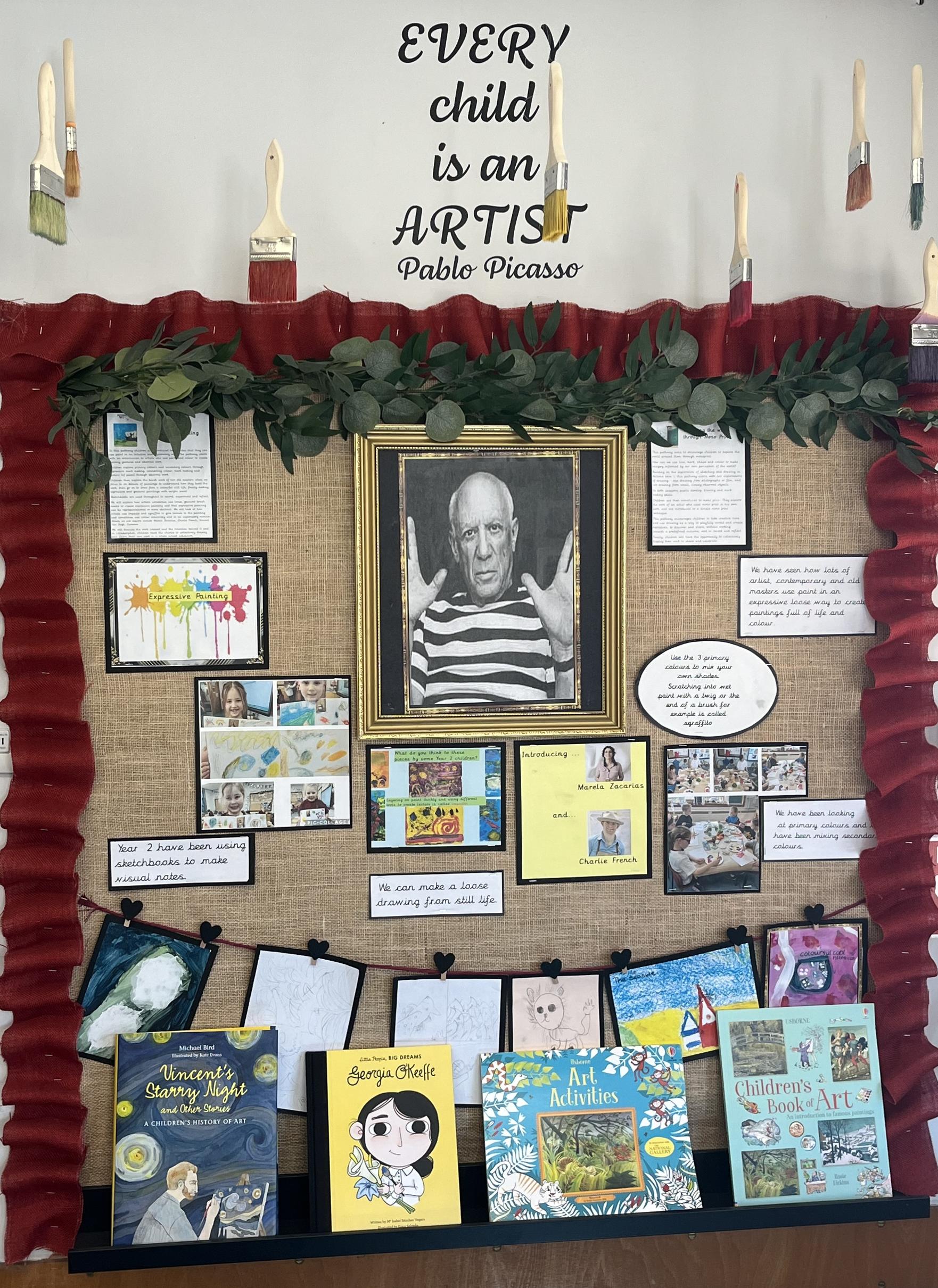
As the arts are a cornerstone of our wider curriculum the children have a dedicated creative area in every classroom or year group shared area, in which they learn art skills. This is equipped with the resources for working to model the process of being an artist. The area is richly resourced with books about artists, famous artwork and key art vocabulary. One of our priorities is reach out and invite a range of local artists into school to share their skills, techniques and work with the children.
Although we have set art lessons, we also believe that regular opportunities for practice, combined with open access to sketchbooks will help create momentum and energy, which in turn will help creativity flourish in all areas. Therefore, we have set aside a weekly slot in the timetable for children in all year groups to access open-ended art activities, when creative resources are available and children have the time and space to follow their own special creative interests, deciding on the subject, artistic concept, resources and outcome.
Impact
Our art curriculum is high quality, well thought out and is planned to demonstrate progression. We focus on progression of knowledge and skills and discreet vocabulary progression also form part of the units of work. We measure the impact of our curriculum through the following methods:
-
Assessing children’s understanding of topic linked vocabulary before and after the unit is taught.
-
Summative assessment of pupil discussions about their learning.
-
Images and videos of the children’s practical learning.
-
Interviewing the pupils about their learning (pupil voice).
-
Moderation staff meetings where pupil’s books are scrutinised and there is the opportunity for a dialogue between teachers to understand their class’s work.
-
Annual reporting of standards across the curriculum.
Examples of our artists’ work is also exhibited throughout the school, both on classroom and communal displays situated on our school corridors.
We also present two whole school Art Exhibitions during the school year, when the school hall becomes a gallery for a week and children present their latest art projects for family, friends and the rest of the school to enjoy and appreciate.
To further raise the profile of art with school, we hold a whole school art day, when each year group produces a collaborative piece of art for display in school.
We believe that art cannot be assessed in the same way as other curriculum subjects. Art is a unique subject and if we are to truly enable creativity in schools then we need to rethink our approach to assessment. Assessment in art is done through a conversation with a child not something done to the child.
Sketchbooks
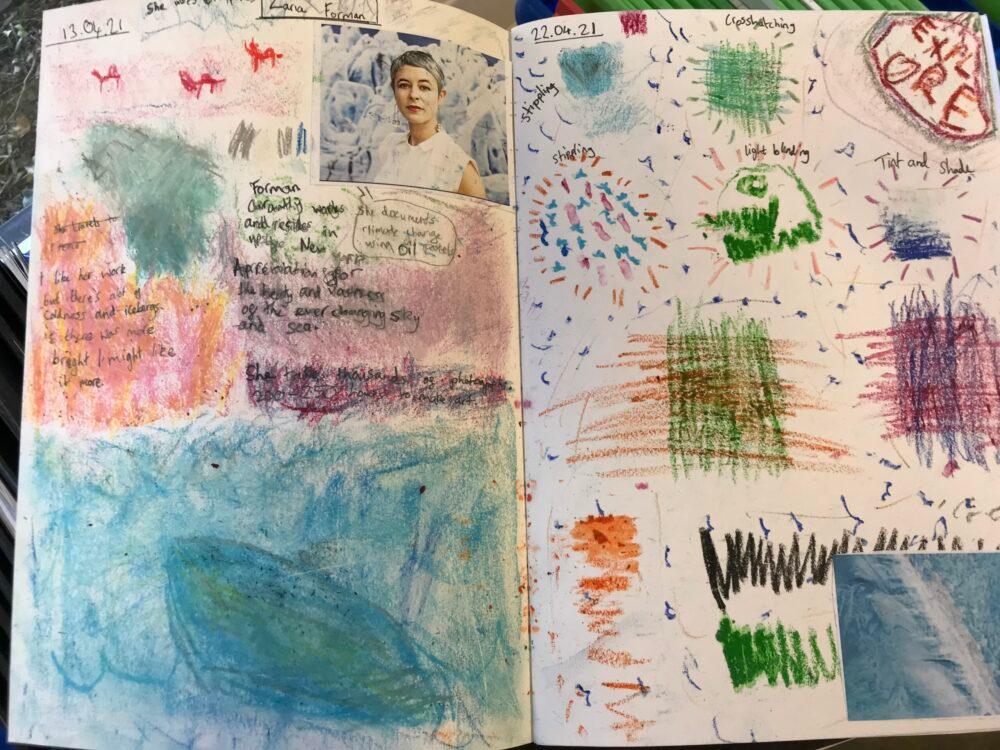
At Signhills, each of our children has their own sketch book in which they can record ideas, practise new techniques and further refine their skills. We believe that our sketchbooks should:
-
give permission. We show pupils what sketchbooks can be in the widest sense, and we give permission for pupils to embrace that potential in an aspirational way.
-
create opportunity for pupils to practice sketchbook skills and explore exciting projects.
-
nurture ownership, by reminding pupils that they can take control of their journey in and through their sketchbooks.
Our sketchbooks are key to how we implement our art curriculum. When we move too quickly towards a preconceived outcome (a painting, sculpture, drawing etc) we deprive ourselves of an exciting journey. Sketchbooks provide us with the opportunity to develop our journeying skills (exploration, testing, reflecting, understanding), which in turn offers us the potential of arriving at an exciting end result, alongside greater understanding and development of skills.
Sketchbooks provide the space for children to play, explore, try, and wonder. They also provide a safe space in which to fail, struggle and get lost, all of which bring growth in vital skills. A sketchbook should be a safe place in which to take creative risks, without fear of judgement. Sketchbooks are places where it is ok not to know the answer. Nothing has to be resolved in a sketchbook, and so conversely, things can be resolved. Sketchbooks should be places in which mistakes can occur, and revelations made. Breakthroughs can be made through repetitive practice, or spontaneous leaps. Sketchbooks are safe spaces in which you can make connections between disparate elements, by daring to put them together.
Sketchbooks are an opportunity to “think around”. Sketchbooks should be a place of exploration and discovery, used to gather, experiment, reflect and understand. We encourage teachers to not be afraid if sketchbooks seem chaotic. Artist’s sketchbooks are full of personality – some sketchbooks are neat and tidy, others are not. All are valid. Sketchbooks are a place to put unresolved ideas into the world, which can be assimilated later. Sketchbooks are rarely linear and a good sketchbook will raise more questions than answers.
Although we have set art lessons, we also believe that regular opportunities for practice, combined with open access to sketchbooks will help create momentum and energy, which in turn will help creativity flourish in all areas. Therefore, we have set aside a weekly slot in the timetable for children in all year groups to access open-ended art activities, when creative resources are available and children have the time and space to follow their own special creative interests, deciding on the subject, artistic concept, resources and outcome.

Impact
Our art curriculum is high quality, well thought out and is planned to demonstrate progression. We focus on progression of knowledge and skills and discreet vocabulary progression also form part of the units of work. We measure the impact of our curriculum through the following methods:
-
Assessing children’s understanding of topic linked vocabulary before and after the unit is taught.
-
Summative assessment of pupil discussions about their learning.
-
Images and videos of the children’s practical learning.
-
Interviewing the pupils about their learning (pupil voice).
-
Moderation staff meetings where pupil’s books are scrutinised and there is the opportunity for a dialogue between teachers to understand their class’s work.
-
Annual reporting of standards across the curriculum.
Examples of our artists’ work is also exhibited throughout the school, both on classroom and communal displays situated on our school corridors.
We also present two whole school Art Exhibitions during the school year, when the school hall becomes a gallery for a week and children present their latest art projects for family, friends and the rest of the school to enjoy and appreciate.
To further raise the profile of art with school, we hold a whole school art day, when each year group produces a collaborative piece of art for display in school.
We believe that art cannot be assessed in the same way as other curriculum subjects. Art is a unique subject and if we are to truly enable creativity in schools then we need to rethink our approach to assessment. Assessment in art is done through a conversation with a child not something done to the child.

|
Art Long Term Plan with big ideas | [pptx 2MB] |

|

|
AccessArt-Progression-of-Knowledge-Skills-with-Links adapted for Signhills Infants Academy KS1 | [docx 3MB] |
|
|
|
Knowledge Organiser Art Year 2 - Spring Expressive painting | [pptx 661KB] |
|
|
|
Knowledge Organiser Art Year 1 - Spring Flora and Fauna | [pptx 652KB] |
|