
Intent
At Signhills Infant Academy we believe that Religious Educations should engage, inspire and challenge our children.
We believe that it is important for all our pupils to learn from and about religion, so that they can begin to understand themselves and the world around them. Religious Education should enable children to explore the different beliefs, values, practices and traditions that are present in our multi-cultural society. It should equip children with the knowledge and skills to answer challenging questions and to develop and reflect on their own sense of identity, whilst being respectful and open minded towards others who may have different faiths and beliefs.
RE plays an important role, along with all other curriculum areas, in promoting social awareness and understanding in our children. It enhances children’s spiritual, moral, social and cultural development. As a school we promote British values, ensuring that children are aware of their rights and responsibilities as UK citizens.
Implementation
Our curriculum is designed to encourage creativity, imagination, enquiry, debate, discussion and independence and understanding.
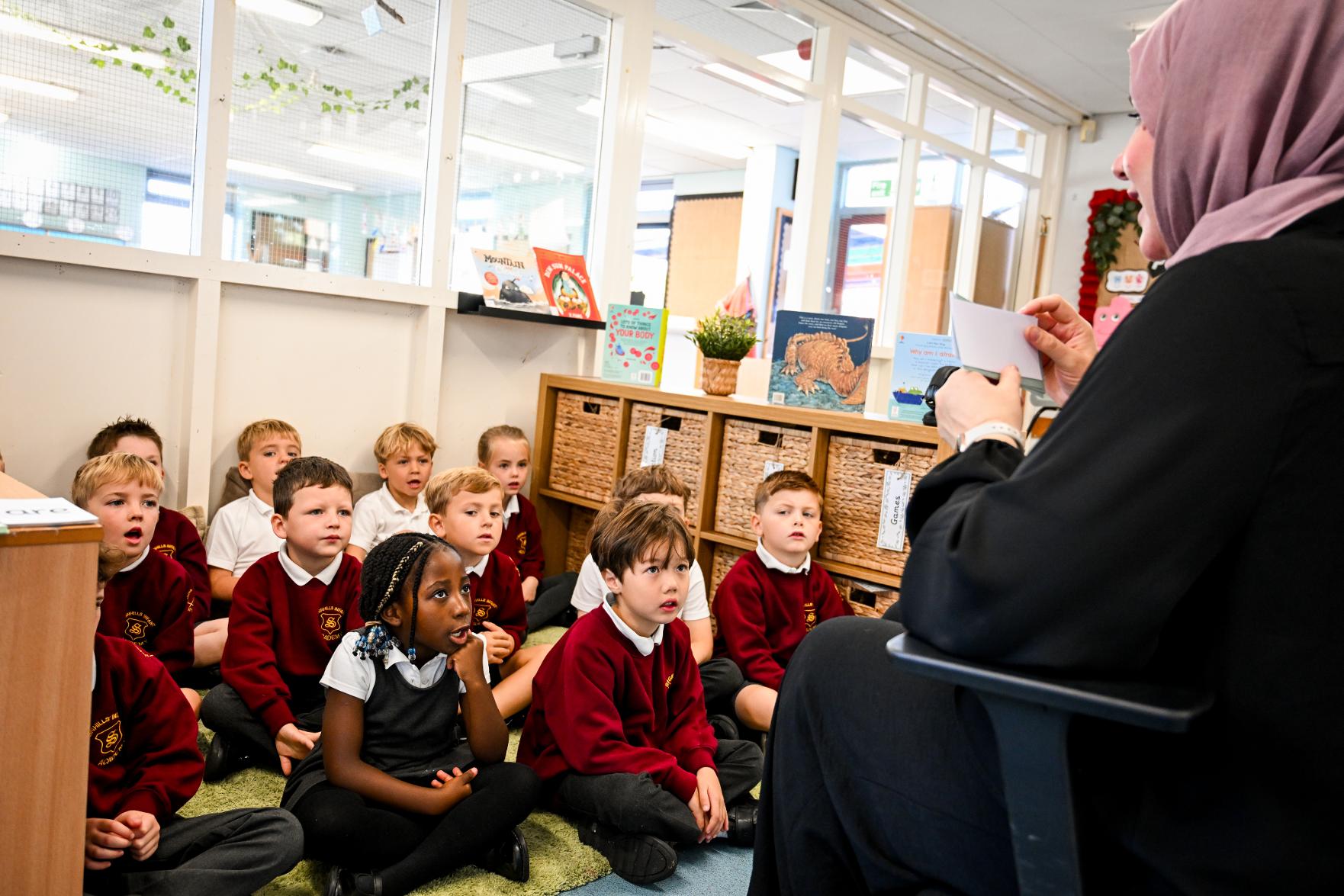
RE teaching and learning is based on an enquiry approach. Our children learn through listening, viewing, exploring, acting, handling objects and discussing. Through listening to stories from different faiths, explanations of practices, video and photographs, our children are introduced to and gain knowledge of their key elements.
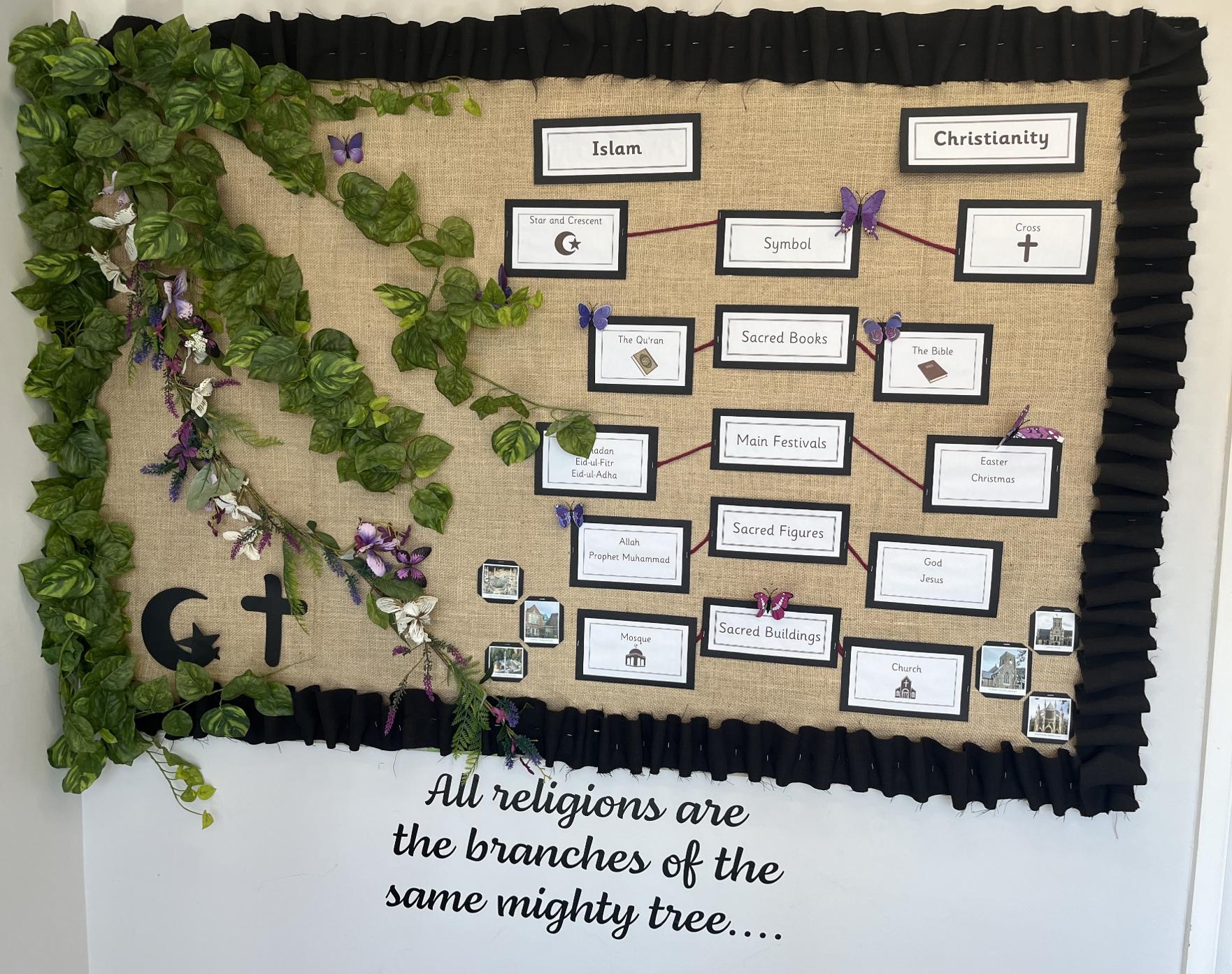
Discovery RE is a comprehensive set of detailed of MTPs for RE from Foundation to Year 2. 16 Enquiry modules are taught covering Christianity, Hinduism and Islam. These provide engaging and challenging lessons for the children to learn about the world around them. Christianity is taught in every year group, with Christmas and Easter given fresh treatment each year, developing children’s learning in a progressive way.
In addition to this and in order to provide full coverage of the Lincolnshire Locally Agreed Syllabus for RE 4 units from this scheme are also taught across KS1. Two discretely and two alongside the Discovery RE units.
Our teaching of R.E. (Using the Discovery R.E. model) is based on a four-step enquiry process.
Step 1 – Engagement
The human experience underpinning the key question is explored here within the children’s own experience, whether that includes religion or not e.g. a human experience underpinning the question, ‘Does God want Christians to look after the world?’ is ‘creation’, so lesson 1 aims to help all children resonate with the experience of ‘creation’ in their own lives. If they can relate to this human experience they will be better able to understand the world of religion into which the enquiry takes them. Their personal resonance with this underpinning human experience acts as the BRIDGE into the world of religion (which may be very much outside of their experience). The BRIDGE concept/experience is shown clearly under the Step 1 box on the planning. This guides the teacher as to the focus of Lesson 1, which does not have to include anything explicitly ‘religious’.
Step 2 – Investigation
The children are guided through the enquiry, gaining subject knowledge which has been carefully selected to assist their thinking about the key question. Depth of knowledge is important so the content covered will be selective. The acquisition of the factual information about the religion /belief system being studied is important, but not as an end in itself.
Step 3 – Evaluation
This lesson draws together the children’s learning and their conclusions about the key question. This activity is used for assessment purposes and we call it a ‘Now Do’. The teacher assesses by using age-related expectation descriptors. This will be in conjunction with the observations of the children’s work and responses through the enquiry. Children’s insights are not bound by literacy skills.
Step 4 – Expression
In this fourth part of the process children return to their own experience to reflect on how the enquiry may have influenced their own starting points and beliefs.
In order to enhance learning our RE curriculum provides opportunities to develop the following skills
- Investigation and enquiry: asking questions; using a range of sources, including sacred texts; talking about key concepts
- Critical thinking and reflection: analysing information to form a judgement; reflecting on beliefs and practices, questions and experiences
- Empathy: considering the thoughts, feelings, experiences, attitudes, beliefs and values of others; seeing the world through the eyes of others
- Interpretation: interpreting religious language and the meaning of sacred texts, usually through stories; recognising and drawing meaning from, artefacts and symbols
- Analysis: to distinguishing between opinion, belief and fact; comparing the features of different religions
- Evaluation: reflecting and drawing conclusions using their experience and knowledge
A NATRE report says that:
- Pupils need to learn subjects in sufficient depth so that they remember what they have learnt
- Planning needs to be sufficiently detailed and sequenced so that pupils develop secure long term understanding building upon what they have learnt before (NATRE, 2020)
Impact
Through inclusive, engaging and memorable RE lessons children at Signhills Infant Academy gain an understanding of different beliefs, cultures and ways of life. During RE children are able to make links between their own lives and those of others in the community and the wider world.
They also develop critical thinking and communication skills as well as learn to express themselves and listen to the views of others.
Children demonstrate their RE understanding (including the use of subject specific vocabulary) through discussions. Drawing, drama, making things and writing.
Evidence of children’s learning is captured in a variety of ways including photographs, Tapestry journal entries, floor books in EYFS and topic books in KS1.
RE is assessed informally during lessons by staff (using observations and questioning) and in KS1 by end of unit assessments.
Children make the best possible progress from their starting points in RE. Children will therefore be expected to leave Signhills Infant Academy reaching at least age related expectations for RE and ready for the next stage of their RE education.