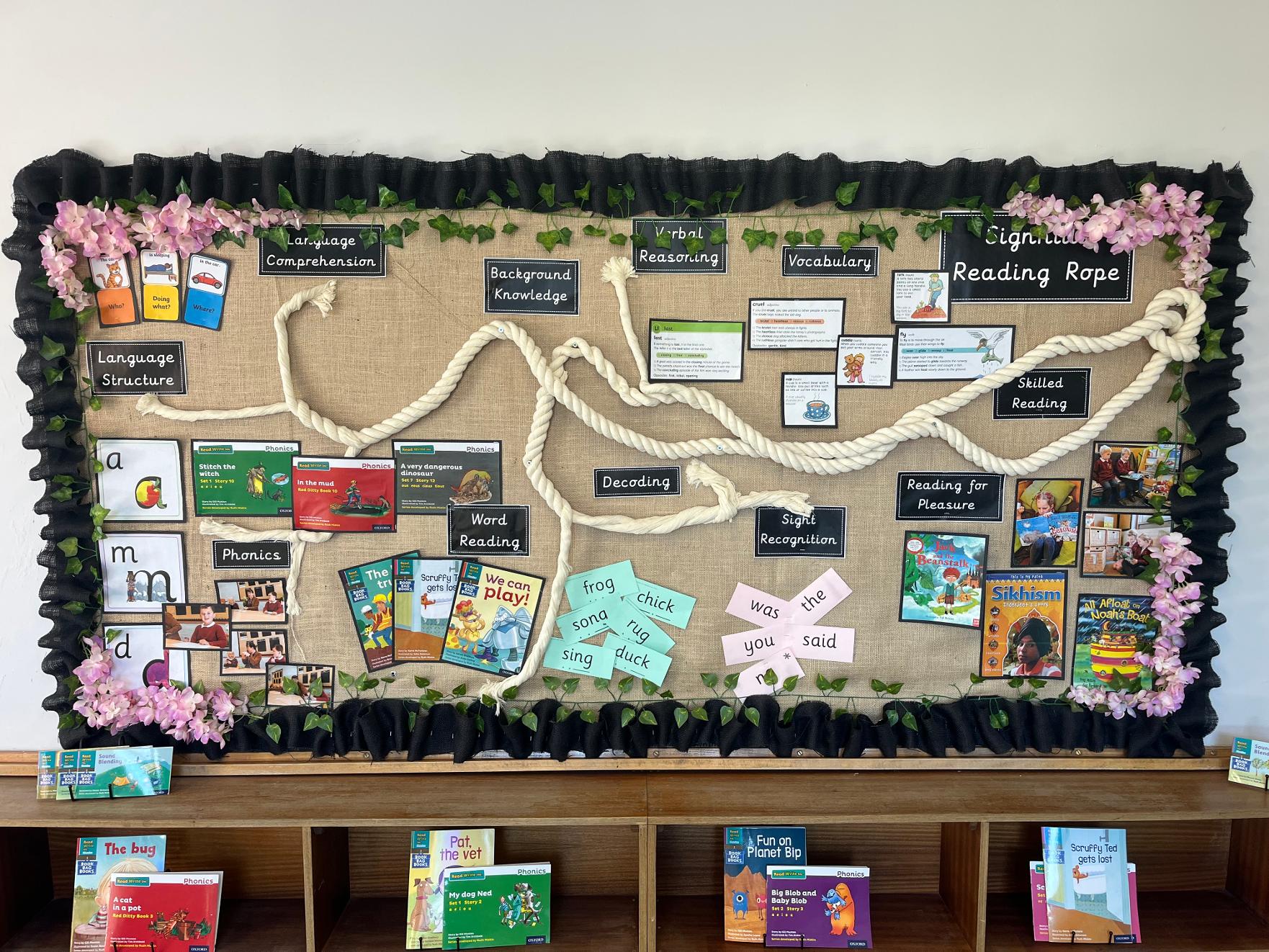
The children listen to and respond to stories and non-fiction texts to build enjoyment and understanding. Through our discrete teaching and curiosity approach continuous provision, we provide opportunities for the children to recognise and respond to print, as well as decode and read in a variety of real-life situations through the use of authentic resources.
Children in our Reception classes learn to recognise which letters (graphemes) represent which sounds (phonemes), this is known as the grapheme-phoneme correspondence (GPC), and begin to make the link between phonics and reading for a purpose. In Reception children begin to read simple two and three letter words using sounds they have been taught such as ‘mat’, later moving on to reading full sentences. Once children are blending sounds into a word, they will take home decodable books from our phonic programme – this will be a book they have read with an adult in school, and one which they have not read but which contains the same sounds. In addition to these children will also select a Reading for Pleasure book from the year group library to share with an adult at home, these books are not suitable for the children to read independently. The EYFS framework, phonic assessments and professional judgements are used to make informed decisions about the children’s next steps.
In Key Stage 1 (KS1) children further develop their phonic knowledge, recognising an increasing number of graphemes including alternative spelling patterns such as ai - rain, ay - play, a-e – make and eigh - neigh, to be able to blend and segment confidently. Our children also learn to read sight words, which are non-decodable, through our phonics programme storybooks which are incremental, building on their daily phonics lessons. As in Reception, KS1 children take home two phonics programme books, one they have read in school, and one which they have not but which contains the same sounds. The children will also select a Reading for Pleasure book from the year group library to share with an adult at home, these books can be ‘swapped’ as often as they like.
Phonics Implementation
At Signhills Infant Academy we have chosen to use Read, Write Inc (RWI) to deliver our phonics lessons. RWI is a Department of Education validated systematic synthetic phonics programme which is designed to get all children reading quickly and effectively.
Daily phonics in Reception
In Reception we initially teach phonics for 10 minutes per day, increasing to 30 minute lessons by the end of the year. The children learn three sounds per week, reviewing them in their Thursday and Friday lessons. This learning is also supported throughout the day with the use of flashcards, Fred and Elly videos, and interactive games to consolidate their knowledge.
Daily phonics in Key Stage 1 (Year 1 and Year 2)
We teach phonics and reading for 50 minutes a day, this is broken down into a 20 minute speed sound lesson, followed by a 30 minute storybook lesson. We use “Fred Fingers” to support the segmentation and spelling of words, with children considering the different spelling choices. The children are placed into phonic groups based on their next steps to build accuracy and fluency in both reading and spelling. Throughout the term our reading teachers continually monitor each child’s progress to ensure they are in the correct group. Toward the end of each half term we also reassess the children using the RWI Portal, to identify any phonic gaps and ensure all children are making progress.
We follow the RWI three-day timetable for all phonics lessons (see below), from the ditty group we introduce the hold a sentence activity, giving children the opportunity to rehearse a sentence and use their new sound.
|
Day 1 |
Day 2 |
Day 3 |
| Daily Speed Sounds Lesson | Daily Speed Sounds Lesson | Daily Speed Sounds Lesson |
| Speed Sounds from the Storybook/caption | Speedy Green Words | Speedy Green Words |
| Story Green Words | Red Word Cards | Red Word Cards |
| Red Word Cards | Partner Practice – Speedy Green Words and Red Words | Think About the Story |
| Partner Practice – Speed Sounds, Story Green Words and Red Words | Second Read – children | Third Read - children |
| Story Introduction | Handwriting – new sound | Questions to Talk About |
| First Read – children | Hold a Sentence – 2 | |
| Read Aloud – teacher | ||
| Handwriting – new sound | ||
| Hold a Sentence – 1 |
Keep up not catch up
We use the RWI One to One Tutoring programme to ensure that any child who has phonic gaps or needs additional practice in phonics has an extra daily lesson, so that they can keep up. These ten minute sessions follow a similar format to the daily phonics lesson with a tight focus on the skill being practised. Year 2 children who have not secured the Phonics Screening Check will receive one to one tutoring to address their phonic gap and support their reading fluency.
Phonics Impact
At Signhills Infant Academy children will make progress in phonics in line with Year Group expectations and make progress from their individual starting points. This supports our children to become confident and resilient readers, who are able to tackle unfamiliar words by applying their phonic knowledge and skills to segment, blend and read both real and nonsense words. Children will also recognise ‘red words’ which are non-decodable (eg to, said, your) when reading and apply these when writing.
Once children have completed the RWI phonics programme and developed the fluency and accuracy to read at 70-80 words per minute, they move onto the RWI Comprehension programme.
The children will also be able to use their phonic knowledge to segment words, using their ‘Fred Fingers’, into their individual sounds to support their spelling. Year 2 children are taught be able to use and apply prefixes as well as suffixes in their writing.
Statutory Assessment
During the Summer Term Year 1 children undertake the Phonics Screening Check (PSC), any child who does not pass the check will re-sit it in Year 2.